Benjamin Bennett, Isil Erel, Léa Stern, Zexi Wang
Review of Finance, Volume 30, Issue 3, May 2026, Pages 887–919, https://doi.org/10.1093/rof/rfaf072
Policymakers often debate paid family leave (PFL) as a social policy, but for firms it also poses an economic puzzle. While it may raise costs by extending employee absences, it could also improve performance by reducing costly turnover and encouraging employees’ investment in firm-specific human capital. Which effect dominates has remained an open empirical question.
Paid Leave Pays Off: The Effects of Paid Family Leave on Firm Performance provides the first clear test of this tradeoff. The authors leverage the staggered rollout of PFL in California, New Jersey, Rhode Island, and New York, applying stacked difference-in-differences and complementary estimators to firm- and establishment-level data from 2001-2021. This approach cleanly separates the effect of PFL from confounding economic trends, allowing them to trace its causal impact on firms.
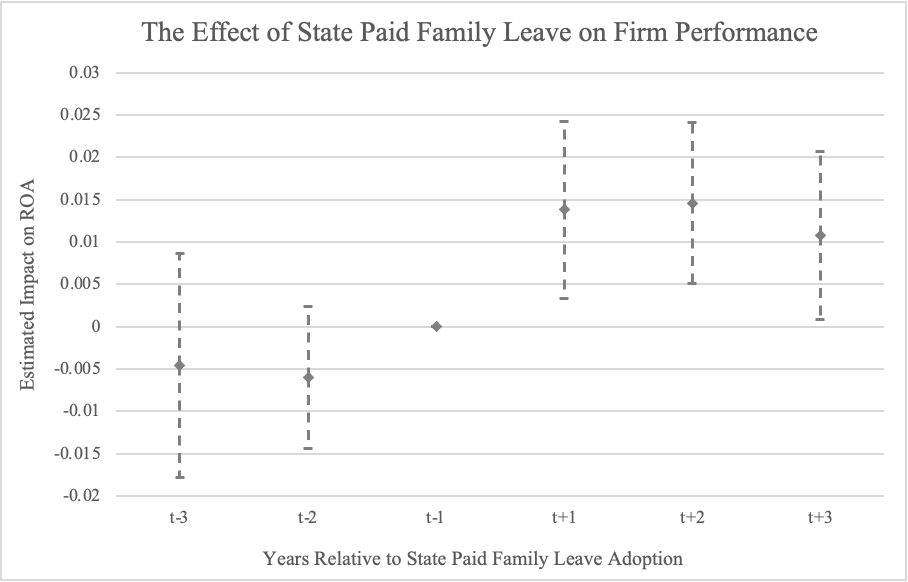
The pattern that emerges is clear. After adoption, treated firms cut costly female turnover, improve labor productivity, and post higher return on assets (ROA). Revenues per employee rise by about 3-4 percent, and ROA increases by about 1.6 percentage points (see attached figure). The gains scale with firms’ actual exposure (the share of their workforce in adopting states) and are especially pronounced in R&D-intensive and intangible-capital-heavy firms, where retaining specialized talent is critical. Moreover, financial markets appear to recognize this: treated firms earn sizable abnormal returns in the years following enactment.
These findings help resolve a core tension: while PFL may indeed carry costs, performance gains dominate. By lowering separation expectations, PFL creates stronger incentives for workers to accumulate firm-specific skills, increasing productivity and profitability, with especially large gains where human capital drives value creation.
Figure 1